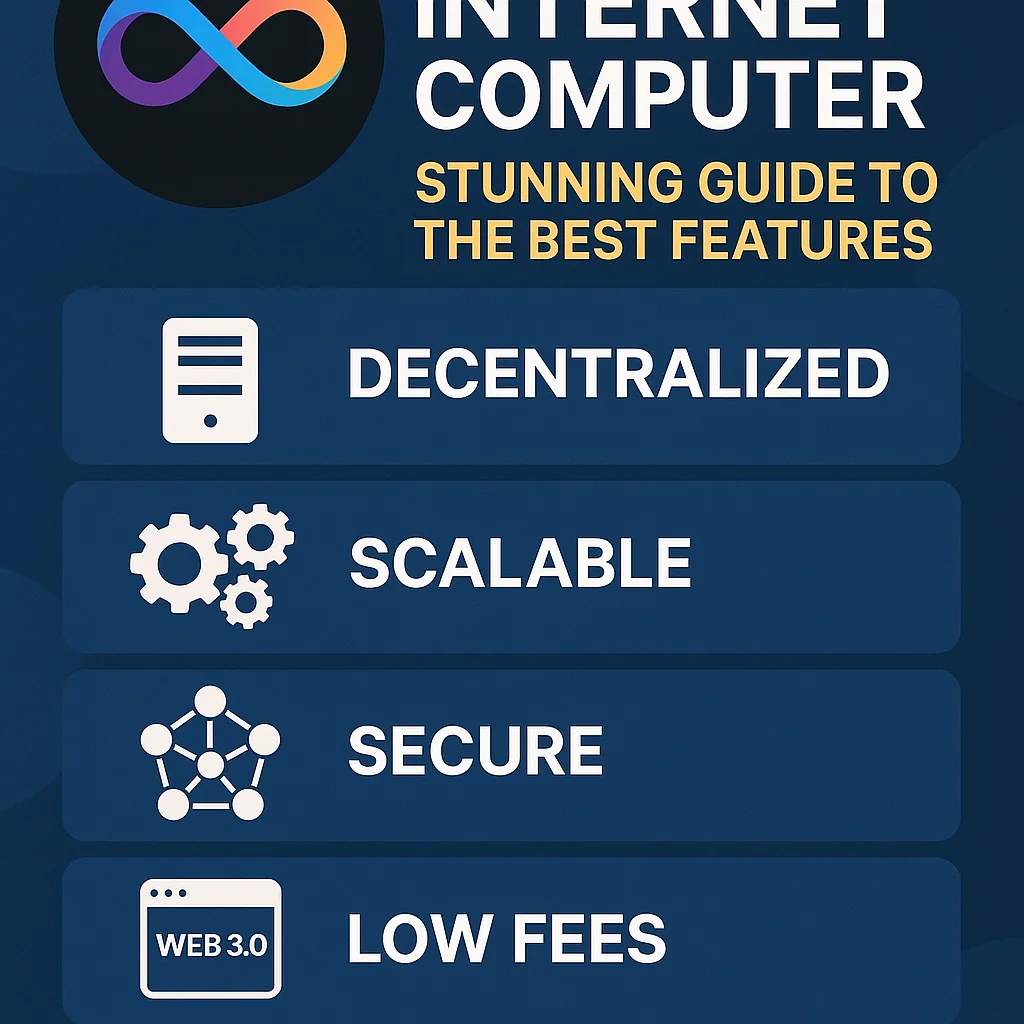
Internet Computer (ICP): Stunning Guide to the Best Features
In this article
The goal is bold: host websites, apps, and smart contracts fully on-chain, at web speed, with low cost and strong security. To understand what this means in practice, it helps to break ICP into its core ideas, how it works, and why it matters.
Internet Computer (ICP) in Simple Terms
ICP is a layer-1 blockchain created by the DFINITY Foundation. It does two main things. It stores code and data, and it runs that code, similar to a cloud platform, but under the rules of a blockchain protocol instead of a single company.
Think of a social media app that runs fully on ICP. The frontend, backend, user posts, and logic all live on-chain. No private servers, no hidden database. The protocol coordinates everything and keeps the system running.
Key Goals of Internet Computer
ICP was built to address several recurring problems in traditional web and standard blockchains. Its design points clearly to these goals.
- Run web-scale apps directly on a blockchain
- Cut out centralized cloud providers like AWS or Google Cloud
- Offer fast response times close to regular web apps
- Provide on-chain storage for actual data and media, not just tokens
- Support upgradeable smart contracts with strong security rules
These targets place Internet Computer in a different category from blockchains that mainly focus on DeFi, trading, or simple token transfers.
How Internet Computer Works at a High Level
Under the hood, ICP combines cryptography, a unique consensus system, and a special way of packaging code. The structure can seem complex, but the core building blocks follow a clear order.
- Nodes and Data Centers: Independent providers run specialized nodes inside data centers.
- Subnets: Groups of nodes form “subnet blockchains” that host smart contracts.
- Canisters: Smart contracts on ICP are called canisters and can hold code, data, and state.
- Chain Key Cryptography: A cryptography system lets the network appear as a single blockchain with one public key.
- NNS (Network Nervous System): A DAO-style governance system manages upgrades and configuration.
This layered design lets ICP scale while keeping a single, unified interface for users and developers.
What Are Canisters on ICP?
On Internet Computer, smart contracts do not live as tiny scripts with strict limits. Instead, they live as canisters, which act like software containers on a blockchain.
A canister can store its own data, run complex logic, keep track of users, and serve web content. For example, one canister could handle user profiles, while another handles chat messages. Both can scale by splitting into more canisters as traffic grows.
The Role of ICP Token
The ICP token plays several roles in the network. It is more than just a tradeable asset on crypto exchanges.
| Use | Description |
|---|---|
| Governance | Staked ICP becomes “neurons” that can vote on proposals in the NNS. |
| Computation Costs | Developers convert ICP into “cycles” to pay for storage and compute. |
| Incentives | Node providers and some participants earn rewards in ICP. |
| Long-Term Alignment | Staking with long dissolve delays signals long-term commitment to the project. |
In daily use, end users often interact with apps without holding ICP directly; developers or app operators handle cycles in the background, similar to how companies pay for cloud servers today.
Governance: The Network Nervous System (NNS)
The Network Nervous System is the on-chain governance brain of Internet Computer. It configures subnets, manages upgrades, and can change protocol rules through open proposals.
Holders lock ICP into neurons. Neurons vote on proposals and earn rewards over time. Long lock-up periods and active voting usually earn higher rewards, which encourages steady involvement instead of short-term speculation.
Cycles and the “Gas” Model on ICP
Blockchains like Ethereum use “gas” to pay for transactions. ICP uses “cycles” as a similar but more predictable unit. Developers convert ICP into cycles, and canisters consume cycles when they store data or execute functions.
Because cycles track the cost of real-world compute resources, pricing can stay more stable than a pure market token price. A developer can estimate the running cost of an app with more confidence and avoid sudden fee spikes during market swings.
Main Features That Set ICP Apart
Several features give Internet Computer a different profile compared with many other chains. These differences shape both its strengths and its trade-offs.
- Web-Speed Execution: The network aims for low-latency responses suitable for interactive apps.
- On-Chain Web Serving: Canisters can serve HTML, CSS, and JavaScript directly to browsers.
- Upgradeable Smart Contracts: Canisters can be upgraded under clear rules, often via DAO control.
- Reverse Gas Model: Apps, not users, typically pay for computation, making UX smoother for mainstream users.
- Chain Key Cryptography: A single public key represents the whole network, which simplifies verification and integration.
For a founder building a social dApp or a decentralized SaaS product, this feature set removes a lot of friction around hosting, fees, and upgrades.
ICP vs Traditional Blockchains
Internet Computer and chains like Ethereum or Solana share some DNA, but they serve slightly different purposes. The table below shows a few core contrasts in simple terms.
| Aspect | Internet Computer (ICP) | Typical L1 (e.g., Ethereum) |
|---|---|---|
| Primary Use | Full-stack apps and on-chain web hosting | DeFi, token transfers, dApp backends |
| Smart Contract Type | Canisters with large storage capacity | Contracts with tight storage limits |
| Fees | Cycles paid mostly by apps | Gas paid per transaction by users |
| Web Integration | Can serve web content natively | Relies on external servers for frontends |
| Governance | On-chain NNS, token-based voting | Varies; often off-chain or mixed |
These differences matter when choosing a platform. A trading protocol might lean toward a DeFi-heavy chain, while a content platform or social network can benefit from ICP’s full-stack focus.
Common Use Cases for Internet Computer
Internet Computer supports a range of applications that go beyond simple token swaps. Several types of projects fit naturally on this network.
- Social networks: Profiles, feeds, posts, and comments stay on-chain, giving users stronger data ownership.
- Decentralized SaaS tools: Productivity or business apps can run without centralized servers.
- Open internet services: Services like DNS alternatives or open identity layers can run as public infrastructure.
- Gaming and metaverse apps: Game logic and assets can live partially or fully on-chain.
- Bridges and multi-chain tools: ICP’s cryptography helps it interact with other chains and web services.
Picture a collaborative writing platform where documents, version history, and user permissions live in canisters. No company holds the master key to the data. Users and DAOs set the rules collectively.
Benefits and Trade-Offs of ICP
Internet Computer offers clear benefits, but it also brings new risks and design choices. Understanding both sides leads to better decisions.
Benefits
Developers gain a unified stack. They can deploy code and store data without stitching together a blockchain, a database, and multiple hosting providers. Users gain apps that can stay online as long as the protocol runs, not just as long as a single company survives.
Governance is transparent. Changes to the protocol go through the NNS. Votes and proposals are visible on-chain, which helps build trust, especially for long-term projects.
Trade-Offs
ICP is still a younger ecosystem compared with some major chains. Tooling, libraries, and community support continue to grow but may not match older platforms for every stack or language.
Governance centralization is a frequent topic. Critics point out the strong influence of early stakeholders and the DFINITY Foundation. Supporters argue that on-chain governance is more open than opaque off-chain decision-making. In practice, users should review governance data and decide their own comfort level.
How to Get Started With Internet Computer
New users and developers can explore ICP in a few progressive steps. A clear sequence keeps the learning path simple and avoids overload.
- Learn the basics: Read high-level docs, watch short explainers, and review project FAQs.
- Set up a wallet: Create an ICP-compatible wallet so you can hold tokens, vote, or test apps.
- Try live dApps: Use a few ICP-based apps to see how sign-in, transactions, and UX feel.
- Install the SDK (for devs): Set up the DFX toolchain and run local canisters.
- Deploy a simple app: Build a small canister, deploy it to a test network, and test real traffic.
Even a basic “hello world” app gives a clear sense of how canisters work, how cycles are consumed, and how upgrades behave on Internet Computer.
Who Should Pay Attention to ICP?
Internet Computer does not fit every project, but several groups benefit from keeping it on their radar.
- Web developers who want to ship full-stack dApps without managing servers.
- Crypto founders who aim for open internet services with strong on-chain governance.
- Researchers who study decentralized computing, consensus, or cryptography.
- Long-term investors who focus on infrastructure with clear technical ambition.
Anyone who cares about open internet infrastructure and data ownership can find ICP an interesting case study, even if they never write a line of code for it.
Final Thoughts
Internet Computer (ICP) attempts a big shift: moving full-scale web apps from centralized clouds to a decentralized protocol. It uses canisters, chain key cryptography, and on-chain governance to support this vision.
The approach carries both promise and risk. For some projects, especially open internet services and complex dApps, ICP offers a direct alternative to the standard “blockchain + Web2 backend” mix. For others, a more traditional chain might still make more sense. The key is to understand what Internet Computer does well, test it with small experiments, and decide based on concrete needs instead of hype alone.